Whole-Home Water Purification Systems in Dallas, PA and Throughout NEPA
Water is essential to nearly everything you do at home or in your business. You depend on it for drinking, cooking, bathing, cleaning, laundry and the operation of water heaters, plumbing fixtures and other equipment.
However, water that looks clear may still contain minerals, sediment or microorganisms that cannot be identified by appearance alone. Private well water can also change over time because of seasonal conditions, groundwater changes, flooding, nearby activity or problems with the well itself.
Sean’s Home Services installs whole-home and commercial water purification systems for private wells and municipal water supplies in Dallas, the Back Mountain and communities throughout Northeastern Pennsylvania.

Cleaner Water for NEPA Homes and Businesses
Water-quality concerns can vary considerably from one NEPA property to another. This is especially true for homes and businesses that rely on private wells.
One property may have hard water that creates mineral scale. Another may experience sediment, iron staining or unpleasant odors. Water testing may identify bacteria or another condition that cannot be seen, smelled or tasted.
Common water concerns include:
- Hard water and mineral scale
- Sand, silt and sediment
- Iron and orange staining
- Manganese and dark staining
- Sulfur or rotten-egg odors
- Unpleasant taste
- Cloudy or discolored water
- Bacteria and other microorganisms
- Acidic water and plumbing corrosion
- Chemical or metal contaminants
No single piece of equipment treats every possible water problem. A water softener, sediment filter and ultraviolet disinfection system each perform different functions.
The right solution may involve one device or several treatment stages working together. The first step is understanding what is in your water and what you want the system to accomplish.
Why Private Well Water Should Be Tested Before Choosing a Treatment System
Private wells are common throughout Northeastern Pennsylvania. Unlike properties served by a public water supplier, private well owners are responsible for monitoring the quality of their own water.
A glass of well water can look clear and taste normal while still containing bacteria, nitrates, metals or other contaminants that cannot be detected without laboratory testing. Changes in taste, odor or color may indicate a problem, but the absence of these warning signs does not confirm that the water is free from contaminants.
Water testing can help determine:
- Which minerals or contaminants are present
- Whether bacteria or other microorganisms have been detected
- Whether the concern affects appearance, taste, plumbing or health
- Which treatment technology is appropriate
- Whether more than one treatment stage is needed
- The capacity required for the property
- Whether pretreatment is necessary
- Whether the installed treatment is working properly
Treatment equipment should be selected for the particular condition identified. A device designed for hardness will not necessarily address bacteria. A UV system can disinfect water, but it will not remove hardness, sediment, metals or chemicals.
If testing confirms harmful bacteria or chemicals, follow the instructions provided by the laboratory, health department or other qualified authority. Do not use potentially contaminated water for drinking or food preparation until the appropriate treatment and follow-up testing confirm that it is suitable for use.
Sean’s Home Services can review your water concerns and available test results when recommending a treatment system for your property.
Common Well-Water Problems in Northeastern Pennsylvania
The appearance, taste and performance of well water can be affected by naturally occurring minerals, sediment, microorganisms and conditions within the well or plumbing system.
Hard Water and Mineral Scale
Hard water contains dissolved minerals, primarily calcium and magnesium. These minerals are not visible while dissolved in the water, but they can leave deposits as the water is heated or evaporates.
Signs of hard water may include:
- White scale around faucets and showerheads
- Spots on dishes and glassware
- Soap that does not lather easily
- Soap residue on tubs and showers
- Stiff or dull laundry
- Mineral accumulation inside appliances
- Scale inside conventional and tankless water heaters
Hardness can make cleaning more difficult and contribute to buildup inside plumbing equipment. A properly sized water softener can reduce hardness minerals before the water travels throughout the property.
Iron and Rust-Colored Staining
Iron in well water can cause orange, reddish or brown staining on sinks, toilets, bathtubs and laundry. It may also create an unpleasant metallic taste.
The correct treatment depends on the type and concentration of iron as well as the water’s pH and other characteristics. A standard sediment filter may capture visible iron particles but may not address dissolved iron.
Water testing helps identify the condition so appropriate treatment can be selected.
Manganese and Dark Staining
Manganese may create dark brown or black staining on fixtures, appliances and laundry. Like iron, it can occur in different forms and may require specialized treatment.
Equipment should be selected according to the test results, water chemistry, flow rate and level of contamination.
Sediment and Cloudy Water
Sand, silt, rust and other particles can enter a plumbing system from the well, water lines or aging equipment.
Sediment may:
- Make water appear cloudy
- Collect in sinks and toilet tanks
- Clog faucet aerators
- Restrict plumbing fixtures
- Damage appliances
- Block small passages in treatment equipment
- Reduce the effectiveness of UV disinfection
A sediment filter can capture particles before they travel through the rest of the treatment system and plumbing.
Sulfur and Rotten-Egg Odors
A rotten-egg odor is often associated with sulfur-related conditions, but the source can vary. The odor may originate in the groundwater, plumbing, water heater or bacterial activity.
Because different causes require different solutions, the water and plumbing system should be evaluated before equipment is recommended.
Bacteria and Other Microorganisms
Bacteria cannot be reliably detected by looking at, smelling or tasting the water. Laboratory testing is necessary.
The presence of bacteria may result from problems such as:
- Surface water entering the well
- Damaged or improperly sealed well components
- Flooding
- Nearby contamination
- Plumbing repairs
- Problems with the well cap or casing
When testing identifies a recurring bacterial concern, the well itself may need to be inspected in addition to installing treatment equipment. A purification system should not be used to ignore a structural or contamination problem affecting the water source.
Acidic Water and Plumbing Corrosion
Water with a low pH may contribute to the corrosion of copper pipes, fixtures and other metal components.
Possible signs include:
- Blue-green staining
- Metallic taste
- Pinhole plumbing leaks
- Premature deterioration of fixtures
- Corrosion around plumbing connections
Acid-neutralizing equipment may be recommended when testing confirms that low pH is affecting the property.
Whole-Home Water Filtration for Well and Municipal Water
A whole-home or point-of-entry treatment system processes water as it enters the property. Treated water is then distributed to fixtures, appliances and equipment throughout the building.
Depending on the treatment system, this can improve water used for:
- Drinking
- Cooking
- Bathing
- Laundry
- Dishwashing
- Cleaning
- Water heaters
- Plumbing fixtures
- Commercial equipment
This differs from a point-of-use filter, which treats water only at a particular faucet or appliance.
A whole-home system may include several components arranged in a specific order. For example, sediment may need to be removed before the water reaches a softener, carbon filter or UV disinfection chamber.
Sean’s Home Services evaluates the water conditions and property requirements before recommending equipment.
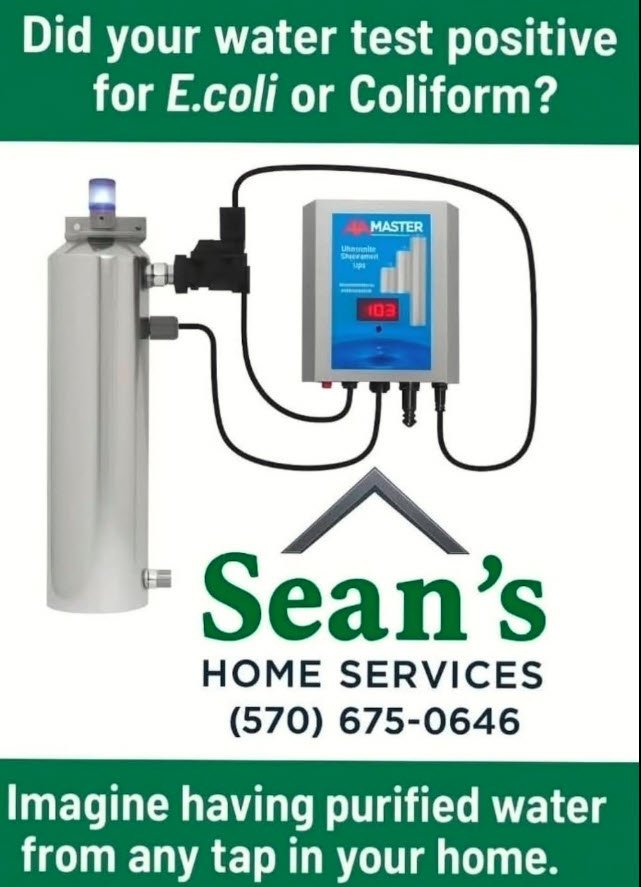
UV Water Purification for Bacteria and Microorganisms
Ultraviolet disinfection is a chemical-free method of treating water for susceptible bacteria, viruses and other microorganisms.
As water passes through the UV chamber, it is exposed to ultraviolet light. When the equipment is properly sized, installed and maintained, the UV energy inactivates susceptible microorganisms so they cannot reproduce.
Potential advantages of UV water treatment include:
- Disinfection without adding chlorine or other treatment chemicals
- No disinfectant taste or odor
- Continuous treatment as water passes through the system
- Whole-home treatment at the main water line
- Residential and commercial applications
- Automatic operation during normal water usage
It is important to use accurate language when describing UV treatment. UV light disinfects water; it does not physically filter bacteria from the water.
Its performance also depends on water clarity, flow rate, equipment sizing, lamp output and maintenance.
Why UV Water Systems Need Proper Pretreatment
A UV system can work only when the ultraviolet light reaches the microorganisms passing through the treatment chamber.
Sediment, cloudiness, color, iron, hardness and other water conditions can interfere with UV transmission. Particles may shield microorganisms from the light, while minerals can coat the protective sleeve surrounding the UV lamp.
For this reason, a UV unit is often installed as the final stage of a treatment system rather than the first.
A complete system may include:
- Sediment filtration
- Iron or manganese treatment
- Hardness treatment when needed
- Carbon filtration when appropriate
- UV disinfection as the final treatment stage
The exact equipment and order depend on the water-test results and property conditions.
Pretreatment can improve water clarity, protect the UV equipment and support more dependable disinfection.
What UV Water Treatment Does—and Does Not Do
UV treatment is highly useful for the correct application, but it is not an all-purpose water filter.
UV Treatment May Help Control
When the equipment is appropriately selected, installed and maintained, UV treatment may inactivate susceptible:
- Bacteria
- Viruses
- Parasites
- Other microorganisms
The specific performance depends on the equipment, UV dose, flow rate and quality of the water entering the chamber.
UV Treatment Does Not Remove
UV treatment does not remove:
- Sand, silt or sediment
- Hardness minerals
- Iron
- Manganese
- Metals
- Dissolved chemicals
- Salts
- Unpleasant tastes or odors
- Other dissolved solids
These conditions require separate treatment technologies. Testing helps determine whether sediment filtration, softening, carbon filtration, reverse osmosis or another treatment stage should be included.
Sediment Filtration for NEPA Well Water
Sediment filtration is often the first stage in a whole-home well-water treatment system.
A sediment filter captures sand, silt, rust and other particles before they enter the property’s plumbing or reach downstream treatment equipment.
Potential benefits include:
- Clearer-looking water
- Fewer particles in sinks and fixtures
- Protection for UV equipment
- Protection for water softeners and carbon filters
- Reduced accumulation in appliances
- Less clogging of faucet aerators
- Improved conditions for UV disinfection
Sediment filters are available in different types and micron ratings. The correct filter must remove the targeted particles without unnecessarily restricting the water flow needed by the home or business.
Filters also require routine replacement or cleaning. A heavily loaded filter can reduce water pressure and interfere with system performance.
Water Softeners for Hard Well Water
A water softener is designed primarily to reduce hardness minerals such as calcium and magnesium. It should not be confused with a drinking-water filter or disinfection system.
Potential benefits of properly treated soft water include:
- Reduced mineral scale
- Less spotting on dishes and fixtures
- Improved soap and detergent performance
- Easier cleaning
- Protection for water heaters
- Protection for plumbing fixtures and appliances
- Less scale inside tankless water-heating equipment
A softener does not disinfect water or remove every contaminant. If testing identifies bacteria, sediment, iron or chemical concerns, additional treatment may be required.
The softener must also be sized according to water hardness, household or business usage, flow requirements and the system’s regeneration capacity.
Iron, Manganese and Odor Treatment Systems
Iron, manganese and odor concerns can make otherwise usable well water unpleasant and difficult to manage.
The appropriate system depends on more than the color of a stain or the description of an odor. Water chemistry affects how these substances behave and how they should be treated.
Important factors may include:
- Iron concentration and form
- Manganese concentration
- Sulfur-related conditions
- Water pH
- Hardness
- Daily water consumption
- Peak flow rate
- Well-pump performance
- Available space
- Whether several conditions occur together
Sean’s Home Services can use available water-test information and property conditions to recommend equipment appropriate for the application.
Activated Carbon Water Filtration
Activated carbon filtration may be included when the objective is to improve certain tastes, odors or chemical-related concerns.
Carbon filtration can be useful for some municipal-water properties where homeowners want to reduce chlorine taste and odor. It may also be one stage of a more complete well-water treatment system.
Carbon does not treat every contaminant, and the filter media eventually becomes exhausted. Equipment should be selected for the specific condition and replaced or serviced according to the manufacturer’s requirements.
Because carbon can remove disinfectant residual from municipal water, system placement and maintenance deserve careful consideration.
Reverse Osmosis Drinking-Water Systems
reverse osmosis system is generally installed at a specific point of use, such as the kitchen sink, to treat water used for drinking and cooking.
Reverse osmosis forces water through a specialized membrane that can reduce certain dissolved minerals, salts, metals, microorganisms and chemical contaminants, depending on the particular system.
A reverse osmosis system may include:
- Sediment pretreatment
- Carbon filtration
- The reverse osmosis membrane
- A storage tank
- A dedicated drinking-water faucet
- Final polishing filtration
Not every reverse osmosis system is designed to reduce the same contaminants. Equipment should be selected according to the water-test results and the manufacturer’s certified performance.
Reverse osmosis is not automatically a replacement for whole-home treatment. A property may use whole-home equipment for hardness, sediment or bacteria while using reverse osmosis at one faucet for drinking and cooking water.
Commercial Water Purification Systems in NEPA
Water quality also matters to businesses. Sediment, mineral scale, staining, bacteria and inconsistent water conditions can affect employees, customers, plumbing and commercial equipment.
Sean’s Home Services installs water-treatment systems for a variety of commercial and light-commercial properties, including:
- Offices
- Restaurants
- Retail properties
- Apartment and multifamily buildings
- Workshops
- Agricultural properties
- Medical and professional offices
- Commercial buildings with private wells
Commercial systems must be designed for the property’s actual demand. Equipment intended for a typical household may not provide the flow rate or treatment capacity required by a business.
Commercial considerations include:
- Daily water consumption
- Peak flow rate
- Number of occupants
- Hours of operation
- Equipment using treated water
- Water-test results
- Maintenance accessibility
- Filter capacity
- Monitoring requirements
- Treatment redundancy
- Applicable regulations
Some businesses using a private well may be classified as a regulated noncommunity water system. Testing, approval, monitoring and operational requirements may apply.
Sean’s Home Services will consider the nature of the property and treatment requirements when planning a commercial system. Property owners are also responsible for complying with applicable Pennsylvania Department of Environmental Protection and local requirements.
How Sean’s Home Services Designs a Water Purification System
A dependable treatment system begins with understanding the water and the property. We do not assume that the same equipment will solve every problem.
Discuss Your Water Concerns
We begin by asking what you have noticed and what you want to improve.
This may include:
- Staining
- Sediment
- Unpleasant odors
- Hard water
- Scale
- Cloudy water
- Changes in taste
- Bacteria identified through testing
- Problems affecting appliances
- Concerns about drinking water
Review Available Water-Test Results
Testing helps identify the specific conditions that require treatment. We review the available information and determine whether additional testing may be helpful before equipment is selected.
Evaluate the Property
We assess factors such as:
- Water source
- Plumbing configuration
- Available space
- Water pressure
- Peak flow demand
- Well-pump performance
- Electrical access
- Drainage
- Existing treatment equipment
- Maintenance accessibility
Recommend the Appropriate Treatment Stages
We recommend equipment for the identified water conditions rather than using a one-size-fits-all package.
A system may include sediment filtration, a water softener, iron or manganese treatment, carbon filtration, UV disinfection or point-of-use reverse osmosis.
Install the Equipment in the Proper Order
Treatment stages must be arranged so each component can perform as intended. For example, sediment and mineral conditions may need to be corrected before water reaches a UV chamber.
We also provide adequate access for filter replacement, servicing and future maintenance.
Test the System and Explain Its Operation
After installation, we check system operation and explain the controls, filters and maintenance requirements.
For a UV system, this includes discussing lamp replacement, sleeve cleaning and any indicators or alarms provided with the equipment.
Recommend Follow-Up Testing
When a treatment system is installed to address a health-related contaminant, follow-up laboratory testing is important. Testing helps confirm that the treatment is addressing the identified concern.
Ongoing testing may also be appropriate for private wells because water conditions can change.
Water Purification System Maintenance
Water-treatment equipment requires maintenance to continue operating properly. Installing the right equipment is only the beginning.
Maintenance may include:
- Replacing sediment filters
- Replacing carbon filters
- Adding water-softener salt
- Cleaning or replacing UV sleeves
- Replacing UV lamps
- Inspecting control indicators and alarms
- Sanitizing treatment equipment when appropriate
- Servicing iron and manganese equipment
- Checking water pressure and flow
- Periodic water testing
UV lamps deserve particular attention. A lamp may still appear illuminated even after its effective disinfection output has declined. Lamp replacement should follow the equipment manufacturer’s schedule rather than relying on appearance alone.
Filter-replacement frequency depends on water quality, filter capacity and property usage. A filter at a commercial property or a home with significant sediment may need attention more frequently than one serving a smaller household with relatively clear water.
Sean’s Home Services will explain the maintenance requirements associated with the recommended equipment.
How Much Does a Whole-Home Water Purification System Cost?
The cost of a water-purification system depends on what the water contains and what the system must accomplish.
Factors affecting the total investment may include:
- Water-test results
- Number of treatment stages
- Equipment capacity
- Household or commercial water demand
- Peak flow rate
- Private well or municipal water source
- Existing plumbing configuration
- Installation space
- Electrical requirements
- Drainage requirements
- Filter and media capacity
- Whether UV disinfection is needed
- Ongoing maintenance requirements
A basic sediment-filtration system is different from a complete system designed to address hardness, iron and bacteria. A commercial installation may also require greater capacity, monitoring and redundancy than a residential system.
For these reasons, a general online price may not provide useful information for your property.
Sean’s Home Services will evaluate the water concern, discuss the recommended equipment and provide a clear estimate before installation begins.
Why Choose Sean’s Home Services for Water Purification?
Sean’s Home Services installs water-treatment systems for homes and businesses throughout Northeastern Pennsylvania.
We understand that NEPA properties can have very different water conditions, especially when they rely on private wells. Our approach is based on identifying the problem, reviewing the property’s water demand and selecting equipment that performs a specific purpose.
Customers choose Sean’s Home Services for:
- Residential and commercial installations
- Experience with private well systems
- Whole-property water treatment
- UV water-disinfection systems
- Sediment filtration
- Hard-water treatment
- Iron and manganese treatment
- Equipment selected for actual water conditions
- Professional system sizing
- Licensed and insured service
- Local ownership
- Clear recommendations
- Service throughout NEPA
Sean’s Home Services is formerly R.N. Fitch Plumbing & Heating. Sean McGrath purchased the company from the Fitch family in 2019 and has owned and operated it ever since.
Under Sean’s leadership, the company has expanded to serve homes and businesses throughout Northeastern Pennsylvania. The new name reflects the broader range of services the company provides today.
Only the name is changing. The ownership, experienced employees and dependable local service customers have trusted for the past six years remain the same.
Water Purification Installation Throughout Northeastern Pennsylvania
Sean’s Home Services is based at 785 Huntsville Road in Dallas, Pennsylvania. We install residential and commercial water purification systems throughout the Back Mountain and surrounding Northeastern Pennsylvania communities.
Our service area includes Dallas, Shavertown, Trucksville, Lehman Township, Kingston, Wilkes-Barre, Pittston, Mountain Top, Tunkhannock, Scranton and nearby areas.
If you are unsure whether your home or business is within our service area, call 570-255-SEAN and tell us where the property is located.
Why Choose Sean’s Home Services for Water Purification?
Sean’s Home Services installs water-treatment systems for homes and businesses throughout Northeastern Pennsylvania.
We understand that NEPA properties can have very different water conditions, especially when they rely on private wells. Our approach is based on identifying the problem, reviewing the property’s water demand and selecting equipment that performs a specific purpose.
Customers choose Sean’s Home Services for:
- Residential and commercial installations
- Experience with private well systems
- Whole-property water treatment
- UV water-disinfection systems
- Sediment filtration
- Hard-water treatment
- Iron and manganese treatment
- Equipment selected for actual water conditions
- Professional system sizing
- Licensed and insured service
- Local ownership
- Clear recommendations
- Service throughout NEPA
Sean’s Home Services is formerly R.N. Fitch Plumbing & Heating. Sean McGrath purchased the company from the Fitch family in 2019 and has owned and operated it ever since.
Under Sean’s leadership, the company has expanded to serve homes and businesses throughout Northeastern Pennsylvania. The new name reflects the broader range of services the company provides today.
Only the name is changing. The ownership, experienced employees and dependable local service customers have trusted for the past six years remain the same.
Frequently Asked Questions About Water Purification
How do I know what is in my well water?
Laboratory testing is the most reliable way to identify bacteria, minerals, metals and other contaminants. Appearance, taste and odor alone cannot determine whether well water is suitable for drinking.
Does UV treatment remove bacteria from water?
UV treatment inactivates susceptible microorganisms rather than physically filtering them from the water. Correct sizing, adequate pretreatment, water clarity, flow rate and maintenance are essential to system performance.
Does a UV system remove chemicals or hard water?
No. UV light disinfects water but does not remove dissolved chemicals, hardness minerals, sediment, iron or manganese. Additional treatment equipment may be required.
Why is a sediment filter installed before a UV system?
Sediment and cloudy water can block UV light from reaching microorganisms. Pretreatment improves clarity, protects the UV equipment and supports effective disinfection.
Can one system treat hard water, iron and bacteria?
A complete system can include several treatment stages, but one individual device generally does not solve every water problem. Testing helps determine which components are needed and how they should be arranged.
How often should private well water be tested?
Testing frequency depends on the property, well history and guidance from local or state health authorities. Additional testing is important after flooding, well repairs, changes in taste or odor, or suspected contamination.
Does a water softener purify drinking water?
A water softener primarily reduces hardness minerals. It does not disinfect water or remove every possible contaminant.
Can hard water damage a water heater?
Hardness minerals can form scale inside conventional and tankless water heaters. This buildup may reduce efficiency, restrict water flow and increase maintenance requirements.
This FAQ should link to the water heater replacement page once it is published.
Do UV water systems require maintenance?
Yes. UV lamps and protective sleeves require scheduled attention, and pretreatment filters must be replaced or serviced. Maintenance should follow the equipment manufacturer’s instructions.
Can Sean’s Home Services install water purification for a business?
Yes. Sean’s Home Services installs water-treatment systems for homes and businesses. Commercial properties and regulated water systems may have additional testing, permitting, monitoring and operational requirements.
Can a water purification system improve unpleasant tastes and odors?
It may, depending on the cause. Carbon filtration, iron treatment and other technologies can address certain taste and odor concerns. Testing and evaluation help identify the source before equipment is selected.
Should my water be tested after a purification system is installed?
Follow-up testing is recommended when equipment is installed to address bacteria or another health-related contaminant. Testing helps confirm whether the treatment is performing as intended.
Improve the Water Throughout Your NEPA Property
Whether you are concerned about hard well water, sediment, staining, odors, bacteria or another water-quality problem, the right solution begins with understanding your water.
Sean’s Home Services installs whole-home and commercial water purification systems designed around the property’s water source, test results and daily demand.
We will review your concerns, explain the available treatment options and recommend equipment intended for the conditions identified at your home or business.
Call 570-255-SEAN today to request a water-purification evaluation.